

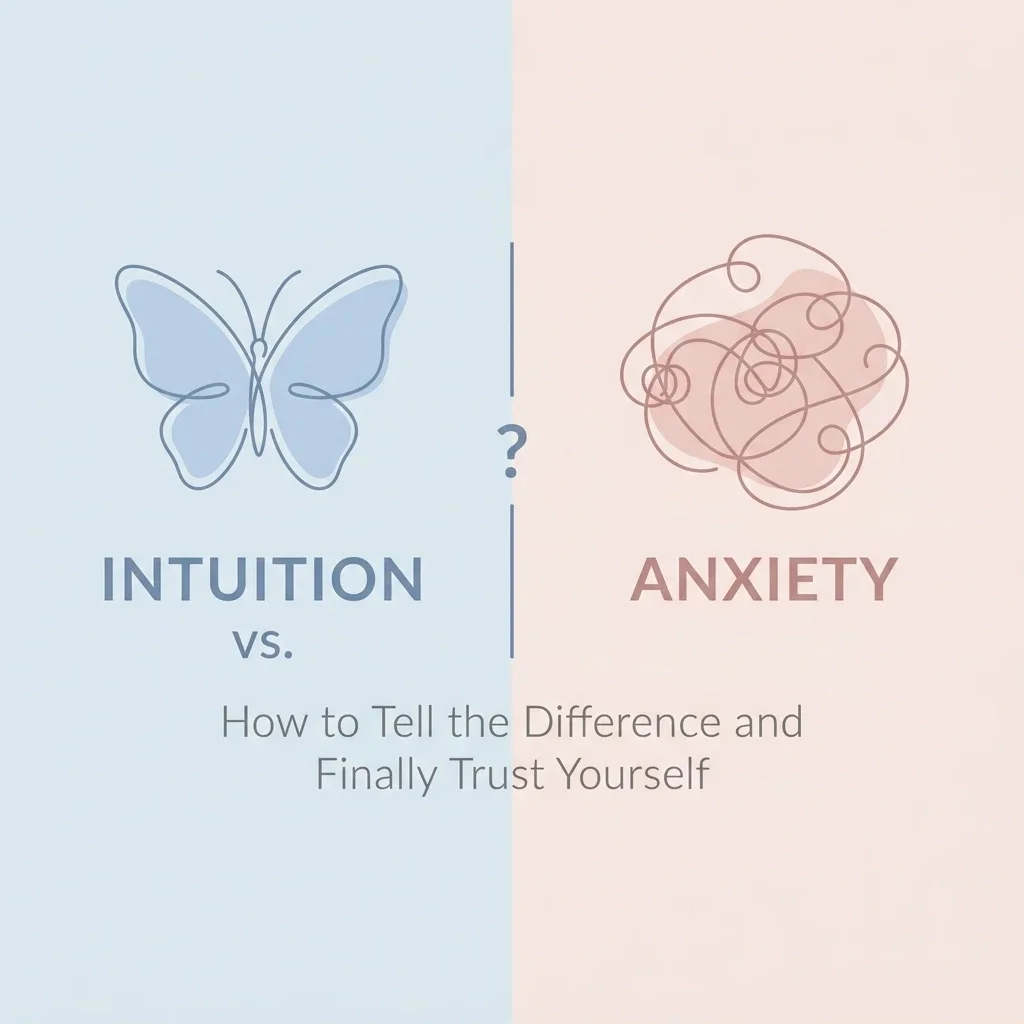
How to Tell the Difference and Finally Trust Yourself
Read our latest news
I spent years living in a state of high alert.
I thought my anxiety was my superpower.
I believed that if I worried enough, I could prevent the bad things from happening.
I told myself that the knots in my stomach were just my "gut feeling" telling me to be careful.
I called it intuition.
But I was wrong.
I was living in a storm, and I couldn't hear the lighthouse.
For a long time, I couldn't tell the difference between the voice of my fear and the voice of my soul.
Maybe you feel that way too.
Maybe you are standing at a crossroads, trying to listen, but the noise is just too loud.
This month at Grace Guidance, we are talking about listening to yourself.
Not the "self" that is trying to please everyone.
Not the "self" that is terrified of making a mistake.
But the steady, quiet self that has been there all along.
The Siren and the Whisper
We often think that important messages should be loud.
We think the truth should come with a trumpet blast.
In reality, intuition is usually the quietest voice in the room.
Anxiety is the siren.
It screams.
It demands your immediate attention.
It tells you that if you don't act right now, everything will fall apart.
Intuition, on the other hand, is a whisper.
It doesn't need to scream because it isn't trying to convince you of anything.
It simply knows.
Anxiety is grounded in "what if."
"What if I lose my job?"
"What if they don't like me?"
"What if I’m making the wrong choice?"
Intuition is grounded in "I am" or "This is."
"I am ready."
"This is the path."
"Wait."
It is a subtle shift from the hypothetical to the present.
The Map of the Body
Your body is a map.
It knows the difference between these two voices long before your mind does.
When I am anxious, my body is tight.
It looks like a clenched jaw.
It looks like shoulders pulled up toward my ears.
It looks like a shallow breath that never quite reaches the belly.
Anxiety manifests as physical discomfort: a racing heart, restlessness, or a heavy ache in the stomach.
It feels like a small fire that quickly spreads through your limbs.
Intuition feels different.
It feels like an anchor.
It feels like a sudden sense of relief, even if the answer it gives is a difficult one.
It is a deep, unexplainable knowing that comes with a sense of peace or confidence.
Sometimes, it feels like a soft chill or a quiet ringing.
But mostly, it just feels steady.
It feels like coming home.
We often mistake the "hardness" of anxiety for strength.
We think the tension means we are working hard at our lives.
At Grace Guidance, we believe strength can be soft.
Real strength is the ability to stay soft enough to hear the quiet nudges of your intuition.
The Timeline of the Soul
Anxiety is obsessed with the future.
It lives in a timeline of "later" and "not yet."
It creates a sense of frantic urgency, wanting answers or action immediately.
It thrives on the idea that time is running out.
Intuition has no deadline.
It is patient.
It targets a specific moment or situation with clarity, rather than scattering across a hundred hypothetical scenarios.
Intuition is quiet and makes itself known gently, waiting for you to be ready to hear it.
If you feel like you have to decide right this second or your world will end, that is almost certainly anxiety.
Intuition can wait.
It will still be there after you take a nap.
It will still be there after you go for a walk.
It will still be there when you wake up in the morning, which is often the clearest moment of the day to trust the guidance you receive.
The Misconception of Certainty
We think intuition means being 100% sure.
We think if we have any doubt at all, it must not be intuition.
This is a misconception.
Anxiety is actually the one that seeks absolute certainty.
Anxiety wants a guarantee that everything will be okay.
Intuition doesn't give guarantees; it gives directions.
It is an inner wisdom that nudges you toward wise action, even when the outcome is unknown.
It is the difference between "I know this will work out perfectly" (anxiety's wish) and "I know I need to do this regardless of how it works out" (intuition's truth).
When we try to force certainty, we often end up holding space for fear instead of for ourselves.
We become trapped in the "how" instead of the "why."
Unlearning the Noise
To trust yourself, you don't need to learn a new skill.
You need to unlearn the noise.
You have to unlearn the habit of looking outside of yourself for validation.
You have to unlearn the belief that your worth is tied to how much you can anticipate and avoid pain.
It is a process of coming back to yourself.
Sometimes, this means sitting in the silence, even when it feels heavy.
I know why silence feels uncomfortable.
It’s because when the room goes quiet, the anxiety usually gets louder first.
It’s like a child throwing a tantrum because it’s no longer being ignored.
But if you stay?
If you sit through the noise?
The tantrum eventually ends.
And in the space that follows, you will find your voice.
Practical Ways to Tell the Difference
When you aren't sure which voice is speaking, try these simple tests:
1. The Time Test
Step away. If you can, wait a few days before making a move.
Anxiety usually changes or fades over time as your emotions fluctuate.
Intuition remains steady. It will say the same thing on Tuesday that it said on Sunday.
2. The Body Scan
Close your eyes.
Think about the choice you are considering.
Does your chest tighten? Do you feel a "pushing" sensation? That’s anxiety.
Does your body feel grounded? Is there a sense of "settling," even if you’re nervous? That’s intuition.
3. The Question Test
Ask yourself: "Is this thought specific and focused, or is it jumping to worst-case scenarios?"
Intuition is a laser. Anxiety is a shotgun.
4. The Journaling Practice
Sometimes we need to see the words on paper to recognize them.
Using a dedicated space, like a listening to yourself journal, can help you track these patterns over time.
From People-Pleasing to Inner-Trust
Many of us struggle with intuition because we have spent our lives listening to everyone else’s needs.
We have mastered the art of turning people-pleasing into people-healing, but we have forgotten how to heal ourselves.
We worry that trusting ourselves will make us "difficult" or "selfish."
We worry that we will set a boundary that hurts someone else.
But your intuition will never lead you toward cruelty.
It will only lead you toward truth.
And truth is the kindest thing we can offer ourselves and others.
Coming Back to the Quiet
Trusting yourself is a journey of a thousand small moments.
It is not a destination you reach and never leave.
Some days, the anxiety will win.
Some days, you will follow the siren and end up exhausted.
That’s okay.
Grace Guidance is about the "guidance" part: the gentle return to the path.
You are not broken for feeling anxious.
You are simply human, living in a loud world.
But remember: the whisper is still there.
It is under the "what ifs."
It is under the racing heart.
It is waiting for you to slow down enough to catch its breath.
Stop.
Breathe.
Listen.
The answer is already inside you.
An Invitation to Reflect
Find a quiet corner and place one hand on your heart and one on your belly. Take three deep breaths, letting the air reach all the way down.
When you clear away the "shoulds" and the "what ifs," what is the very first thing your quietest voice says to you?
Add comment
Comments